
Search engine optimization is a well-established function in growth and inbound marketing organizations. But in a way the very acronym “SEO”, which describes optimizing a site for a search engine, is a misdirection.
The goal of search optimization is instead to optimize a channel. Prioritizing search as a channel rather than something that you “do for Google” is a helpful shift in perspective which can help keep your SEO program aligned with business goals, and remain focused on building for your users, rather than for search engines.
Let’s jump in.
Searcher or Search Engine?
On the level of basic optimization, it is critical to understand which activities are aimed at Google, and which are aimed at users.
| Optimization | For a search engine | For a channel / your customers |
|---|---|---|
| Keyword strategy | x | |
| Improve load performance (ex. speed, jank) | x | x |
| Segmenting channels and optimize search for revenue, signups, etc. | x | |
| Tracking user retention goals | x | |
| Submitting a sitemap | x | |
| Findable site architecture | x | x |
| Ensuring JavaScript containing critical contents or links are rendered server-side | x |
To summarize, there are a few basic optimization which are directed at search engines; and others which are for your business channel.
Within both, I believe there are optimizations which can be regarded as “making life easier” for search engines, and “making life better” for users.
Making life easier for search engines:
- better load performance
- submitting sitemaps
- reducing Javascript sizes (and rendering all critical JS on SSR)
Making life better for users:
- better load performance
- reducing Javascript sizes (and rendering all critical JS on SSR)
- better information architecture / findability
Of course, many optimizations which are “for” search engines have major roundabout effects on your ability to get your content in front of your users. Speed and good technical UX (less jank, no flicker) is integral to the user experience. And a sitemap, for example, is a best practice for any site and might, at the very least, support syndication of your content offpage.
But spending time manipulating your <changefreq> tags is likely a low-impact optimization if you don’t have a massive site with crawl budget constraints, indexation issues, and rapidly changing content. Conversely, a well-architected internal linking structure is a user-first feature, but does also dovetail with a search strategy which is “for search engines.”
How to resist SEO
I argue that this problem of optimizing for search engines doesn’t really inhere in Google itself, or in any of its messaging around the value of search, but instead in the kind of value propositions presented by SEO tools, who are also some of the primary generators of thought leadership content in the SEO industry.
Successfully leveraged SEO tools, however, rely on real-world SEOs, working deeply with and understanding business needs in order to bring about bottom-line impact through search. To do that, tools are integral, but it is much more about how the tools are leveraged. Without domain knowledge, tools they risk recapitulating the primordial problem of organic search data: the undifferentiated mass of huge volumes of low-granularity keyword data. From a strategic perspective, these data mean very little on their own.
Here are some questions you can ask to determine whether you are focusing more on your channel or on a search engine:
Are you working with a strong funnel focused on your customers?
Both the work of accessing your keyword data, and the work of honing in on your customers’ intent are major parts of defining your funnel on search. What the funnel looks like will depend on your business’ model and strategy. But a major indication that you are focusing on search as a business channel is that you have meaningful segmentation which is not oriented to sheer volume.
A customer funnel may naturally have higher-trafficked keywords at the top and lower-trafficked keywords at the bottom. But it is also integral to have a clear concept of goal-setting for every stage, and correctly map those goals to templates that aim to satisfy your customers.
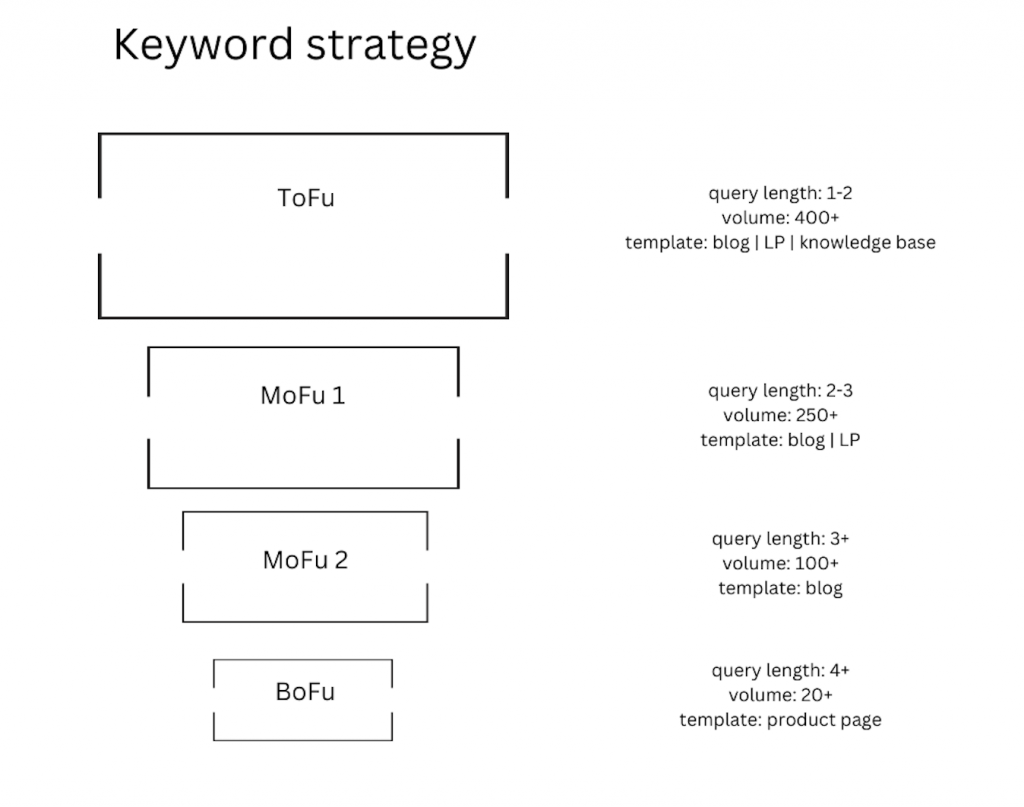
If you are product-led (meaning your company/client has a reasonably scaled or scaleable web product which is core to its business), SEO should be a major part of bringing high intent users as close as possible to goals across the templated pages which drive for engagement and signups. Engagement starts early, and organic search can be a major driver. Your efforts should focus on identifying customer intents that map to a growth goal (e.g. an acquisition, a freemium signup, a lead), and then connecting the dots through search.
If you are not product-led, a strong funnel structure will help establish how and where SEO drives goals. You want to both be able to meaningfully map keywords to real customers, while also being able to support business-driving goals for which organic search is in a complementary or support capacity vis-a-vis other channels (more on channel segmentation below).
Those goals may include making respective templates available to users across the corresponding stages of their purchasing journey. Measuring your traffic to these page types, indexing your success in terms of traffic potential (share of voice), and demonstrating revenue goals at each stage are potential channel goals.
Takeaways:
- A strong search funnel structure is critical to helping place SEO among other channel efforts. It’s a good idea to keep an eye on and think about how search works with search engine mechanics in mind. But think about topical authority, rankings, and share of voice as ultimately part of marketing to your customers as well.
- If you are practicing product-led, focus on customer problems and search intents, and go in hard on segmenting keywords for scale according to user need (intent) and expected outcome (template/goal).
Index technical SEO efforts to your market
From the time Google introduced its Core Web Vitals in May 2020, SEO teams scampered to improve sites’ technical performance. And this was a net positive, as technical performance is clearly a user-first feature.
But it also led to cases where teams overindexed on technical UX, where the difference to users was very marginal, and the difference to rankings was imperceptible.. For an ecommerce company, improvements in time to first byte or cumulative layout shift can lead to more indexed pages, lowered bounce rates, more time on page, better rankings on search, and ultimately more revenue. But for other companies, marginal gains in these metrics may make little difference, either for the end-user or in terms of search engine rankings.
Takeaways:
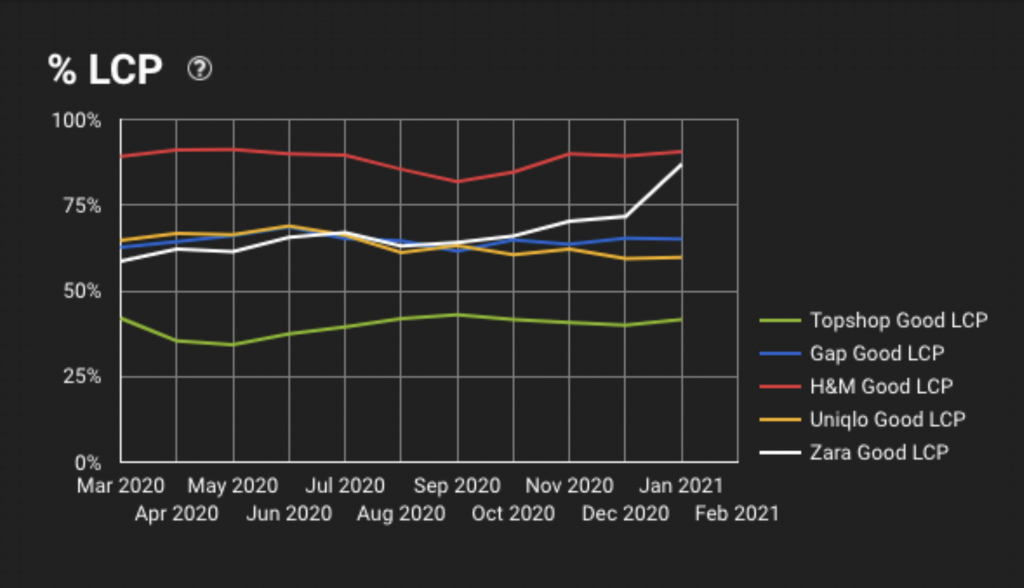
- If you are in a space where technical performance makes a meaningful difference to your customers, it will like make a meaningful difference to search as well. The momentum should move in that direction. PageSpeed Insights or Lighthouse are great for diagnostics and problem-solving (especially at the URL-level), but it is preferable to look at recorded CWV data in the Core Web Vitals panel in your Search Console, and to get real “field” data from the Chrome User Experience Report (CrUX). I recommend customizing this great dashboard so you can pay attention to your closest competitors’ performance. And if you combine competitor CrUX metrics with competitor rankings, you can get a decent sense for whether and how technical performance makes a difference in your space.
Channel segmentation: think of search firstly as a channel among others
A part of a human (or customer) centered SEO strategy is making sure you have a strong concept of channel segmentation. If organic search tends to drive traffic and revenue to specific types of pages, and from customers at particular places in their purchasing journey (seen via their search intent), then that’s a place to focus in for your SEO strategy. Connectedly, it’s important to focus on building or optimizing content that is actually right for the channel at hand. Search is almost never the right channel for any form of gated content, for example, and there are strong limitations on the ability of search to grow brand awareness directly.
Takeaways:
- Optimizing your search channel requires making your way down-funnel, while also strategizing by exclusion. On the one hand, you don’t want to be optimizing “for Google” (in reality, optimizing only for volume and against competitors is a bit more in line with value promoted by SEO tools, including the Search Console). On the other, optimizing for the full funnel requires pursuing an understanding of what content “plays” through organic search, even at low volumes – and what simply isn’t meant to.
Is your linkbuilding strategy about you, or about an ancient PageRank calculus?
For the time being, building or growing links is a meaningful factor in ranking. That being said, Domain Rating (DR) as a primary measure of backlink strength is not a qualitatively strong metric. Pursuing it through active linkbuilding can lead to penalties if done poorly, as well as irrelevant links, and money poorly spent. These are all resources which could be better pointed towards building out the contents and functions which passively attract higher quality links.
“Magnetic content” which is fun, useful, unique, interactive, informative, eye-catching, shareable, embeddable – all of these of attribute of content that attracts links, whether through direct link-building, or through the simple act of sharing.
Takeaways:
- For growing links, focus on building towards partners who demonstrate expertise, authority, and trustworthiness (EAT) in a space which is topically relevant to to your own. Coupled with an outreach component, producing content featuring tools, templates, and fun, useful, or interactive features is a great strategy for acquiring links from relevant sites. In this case linkbuilding becomes part of your growth strategy, rather than a sore thumb on top of your other efforts.
Conclusion
SEOs necessarily spend a lot of time with Google products, as tools, platforms, and data sources. We can at times slip into optimizing for search engines, or without focus and advocacy around our channel, be understood to be optimizing for search engines, rather than for our users. Focus on search channel optimization – the practice of optimizing your channel for your customer. Many of the tools and methods you use to execute a product or customer-first SEO strategy will remain constants, but the outcomes will be better aligned with business goals.