In thinking about whether or how to localize, teams sometimes turn to organic search as one way to measure market demand. The goal of an SEO specialist in this process is to be able to return actionable information which can inform localization teams and decision-makers; conversely, loc teams can also benefit from an understanding of how SEO research and processes can provide them with critical audience insights.
While there are indeed recommendations SEO can make in setting about on localization planning – which I detail below – one cautionary note up front:
Onboarding SEO to your international marketing does not amount to automatic and costless upside. In most cases, there are two requirements in trying to get localization and SEO efforts to dovetail to optimal effect:
- Localization needs to build toward your audience and your customers’ intent as effectively as your source language does.
- In most cases, optimizing content for search requires more than “layering” keywords on top of your localized contents (even when you’ve found the right in-language keywords).
Localization and search optimization are united by the need to build towards your customer. In the same way as localization itself, optimizing for search requires content to finely reflect an understanding of customer intent. While a keyword can point the way, for longform or less idiomatic content, placing it in a meta title and H1 is no guarantee of ranking or revenue.
To understand why and how to introduce SEO into an international program which includes localization, think more about how SEO can be leveraged in support of localization strategy. I want to share two high level thoughts on how SEO thinking and processes can support localization planning.
Using SEO for market insights (or, whether to localize)
Despite the surface appearance of SEO data as a kind of “trends of the worlds” almanac, it should probably not be relied on for deep insights into markets in which you otherwise have low visibility. Admittedly, not many SEOs (not to mention business strategy folks) are really tracking lists of 100s of keywords on search as market data for the world beyond search. And it’s worth taking a second to say why that is the case.
SEO data sources and metrics are primarily useful for understanding things as they exist presently. If you do happen to have a set of keywords for which you need help forecasting, in any language, I suggest transitioning those into a trends forecasting tool supported by Google Trends (I recommend using this great Streamlit app by Lee Foot which combines Google Trends with NeuralProphet, and running the code locally). The primary limitation with any method based on Trends is that its data tends to not be available for real-life search queries as you may encounter them in your Search Console: Trends tends towards bucketing keywords, so it is truly for higher-level insights.
So how can SEO be leveraged for market insights?
Brand awareness (branded search): If you can reasonably expect there to be searches for your product in a local marketplace, and you either know that your product could benefit from localization (generally advisable for ecommerce), or have intel that it could, it may be worthwhile investigating or monitoring branded searches using 3p or Search Console data.
Simply bear in mind whether or not your brand name is a fairly generic word, in either/both source or target language. Consider divergences between searches for “Lattice” in Italy and in the US:

Whereas the top result for Lattice in Italy returns the Wikipedia page on “latex”, in the US, brand recognition clearly makes a huge difference:

As a contrast case, consider Personio. The dual effect of non-generic brand name and brand recognition makes it such that it appears at the top of search results in the US as well. Despite the fact that their product hasn’t actually launched in the US, it has enough signal as a named entity that it could nothing else but Personio, the HR solution:
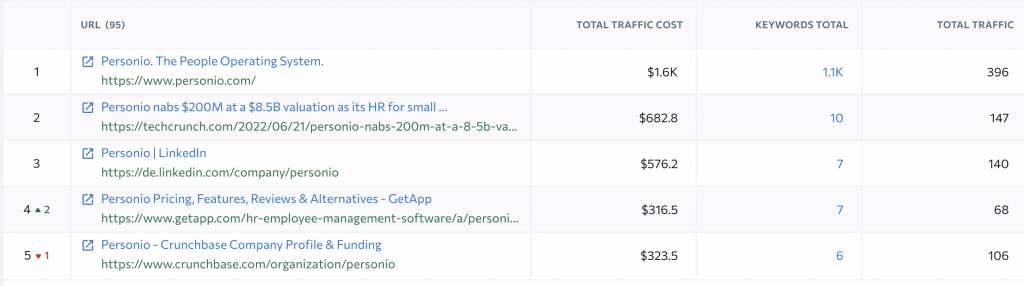
Of course, all of this presumes that you already have not only a search market but also a business market more generally more or less defined. If you don’t yet have that data, I recommend doing some market research yourself, for which my favorite solution is accessing Diffbot’s knowledge graph to calculate your total addressable market off of search. This can be valuable if you are in a B2B space, where understanding the market space according to delineable categories provides immediate and high-level industry or market insight, for example if you are looking for hospital chains in South Korea with over 500 employees.
Market insights (non-branded search): Rather than looking for trends and insights on an ongoing basis, SEO can be a useful source of data for understanding whether to localize in the first place, based on organic search being a major part of your growth loops or an integral part of the path to purchase for your business. In other words, it can show qualified demand through organic search in particular.
This process involves researching across an array of business-integral keywords in localized languages. If you already have known competitors with localized contents operating in a potential target market, it may be enough to observe at a high level whether they are bringing in considerable volumes of traffic to critical pages from non-branded searches to inform a decision about whether to localize. If this competitor is bringing in much more traffic than you are with localized content, consider the unit economics of localization vs. forecastable revenue, beginning from a simple Channel > Traffic > Conversion Rate calculation.
If you are in a more ambiguous space, however, it may be good to have a stronger hold on the exact localized keywords you will be targeting. (Elsewhere I will suggest a method for multilingual keyword research that can support your team’s keyword localization efforts.)
Higher quality localization (or, how to localize)
(Confusingly,) SEO is no longer as keyword-oriented in the way that it once was. While keywords and SEO may seem basically identical, optimizing your pages for search requires accounting for all of the text on a given page – not just for the keyword that will make its way into your meta title and H1.
This is a case in which SEO can actually provide some strong and meaningful guidance into how you can structure your translations and localization assets for the long term. How a site fares on organic search is in a sense a product of the site itself: its structure, its internal link graph, and its content. But in localization, going the extra mile means getting involved with your linguistic assets – the all-important translation memory (TM) and glossary.
For now, it’s enough to recognize that semantically unpacking ranking pages on search in a local market can provide a lot of direction for linguists, based on tone as well as term usages by highly authoritative and well-trafficked players in your space. Controlling for linguistic choices in this more holistic way, keywords are suddenly quite at home among the words they should be.