
It is sometimes believed that the goal of a search-engine friendly information architecture is to be as “flat” as possible. The reason for that is fairly simple: a flat architecture means ease of access via links from the homepage, as well of a strong and fairly horizontal consolidation of linking authority.
While it may seem at first glance that this architecture could or should only be achieved by sites with relatively few pages, the actual conditions in which it becomes an optimal solution from an SEO perspective depend on a number of other factors which may be in the mix, depending on site type, page number, and other features.

Below I’ll describe a few different use cases for and possible implementations of flat information architecture.
What do we mean by a flat architecture?
Pages which are accessible within three clicks from the homepage (are equal to or less than a “click depth” of three).

What is the alternative?
There are two basic alternatives to a flat architecture: unlinked chaos, and networked linking across pages at different depths. In the first case, users and crawlers alike have trouble navigating a site’s information architecture through links. In the latter case, site owners leverage different onpage or backend elements to create structures for scaleable but less “vertically determined” or hierarchical linking, often involving a recommendation algorithm.
When does flat architecture make sense?
To understand when flat architecture makes sense, begin with your product. Is your product news articles? Software integration pages? Traditional product SKUs numbering into the thousands and millions? The ability of products to be reflected at scale as indexable pages is integral to SEO strategy on any large site. But at the same time, having “too many” products can make the dream of being reachable within three clicks of the homepage untenable as an information design.
In general, scaleable site architectures reflect decisions based on the balance between two realities: page classifiability and page uniqueness. For pages which are more easily classified into categories (such as ecommerce product pages or mortgage rates by zip code), the primary problematic is page quantity and category interest. This scenario points towards a flat architecture as the strategic destination.
For pages which are fairly unique (such as daily news articles or UGC on forums), the primary problematic is page similarity. This second scenario generally requires strategies involving more contingent linking strategies among individual “product” pages. Cumulatively, this architecture has the possibility to be technically “flat” in terms of click depth, but a lot of testing, cross-linking criteria, and regular monitoring is required.
In SEO, information architecture is about how well individual pages can be “subducted” to or be organized as children of categories; and how likely those category pages are to themselves drive traffic. How many article/product/listing/integration pages do you have, how many can you fit onto category pages, and how many category pages can you create? That’s just the math, but the math must connect with your IRL needs. Do those categories make sense? Do they bring value to a user? Are they things people are already searching for (and therefore make plausible entrypoints to these pages from search)?
In terms of search behavior, users are relatively unlikely to search in large volumes for news articles that are no longer current, for example – even though traffic to those pages may still drive business goals, as in the case of display ads or affiliate link placement. However, depending on how your users search for news, it may not make sense to topload your architecture with categories to define news segments. This depends on both search and user preferences onpage: the question is whether or not those categories actually correspond to user needs. Without such categories, a flat architecture is neither achievable nor a meaningful goal. Other strategies leveraging a meshed architecture and recommendation algorithms will be more lucrative.
E-commerce shops, however, are great examples of cases in which flat information architectures do support your customer’s and their preferred behavior. For one very successful example., consider the case of REI:
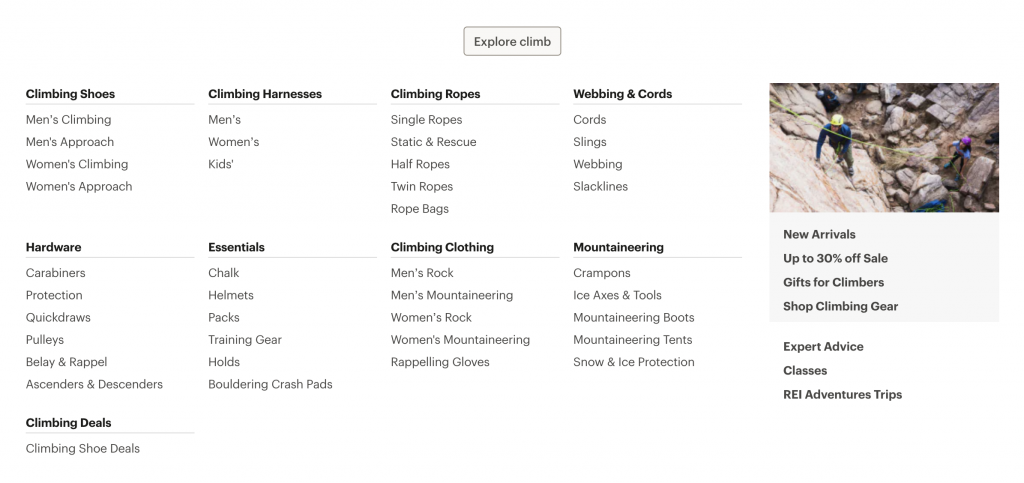
The screenshot above captures the flyout for a single tab, under which are contained dozens more category pages.

This structure repeats across hundreds of categories, like “snowboards”, “knives”, and “boots”. This architecture is an incredibly effective solution for REI, for the following reasons
- Their SKUs are many, but they can be “repackaged” across many possible recombinations of categories, such that they can all be found easily.
- The categories which REI leverages are intuitive to customers, and match how they seek information (i.e. their search intent). For this reason, their architecture is an enormous boon to an SEO strategy.
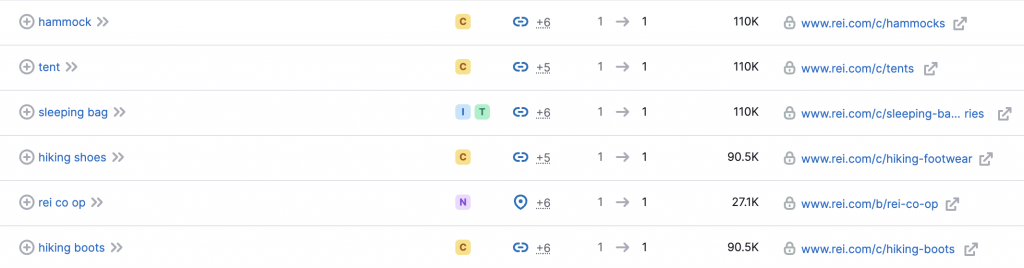
- Even with heavily loaded categories at the top-level, REI still has opportunities to create yet more categories which are linked from the category pages. For other categories which have attestably relevant and significant search traffic, categories are created and links to these pages are featured in place of internal search results pages (which must be excluded from crawling on the basis of query parameters in URL paths). Consider the following example, on the category page https://www.rei.com/c/mens-footwear:

REI produces indexable category pages for these more specific product searches. Cumulatively, these features together achieve all the objects and benefits of a flat architecture strategy, including:
- Ease of access (= good internal linking) to all product pages from homepages or any point of entry.
- Categories which themselves are critical and targetable topics on search. The stronger those pages are, the better support they can offer products on search.
- Through placing links in product listing and internal search interfaces, creates more categories which enhance access, improve linking structure, and ultimately produce better traffic both to these pages and directly to products.
To recap, the benefit of such an architecture is its ability to create regular and maximal linking patterns between category and product pages both “down” and “across”:
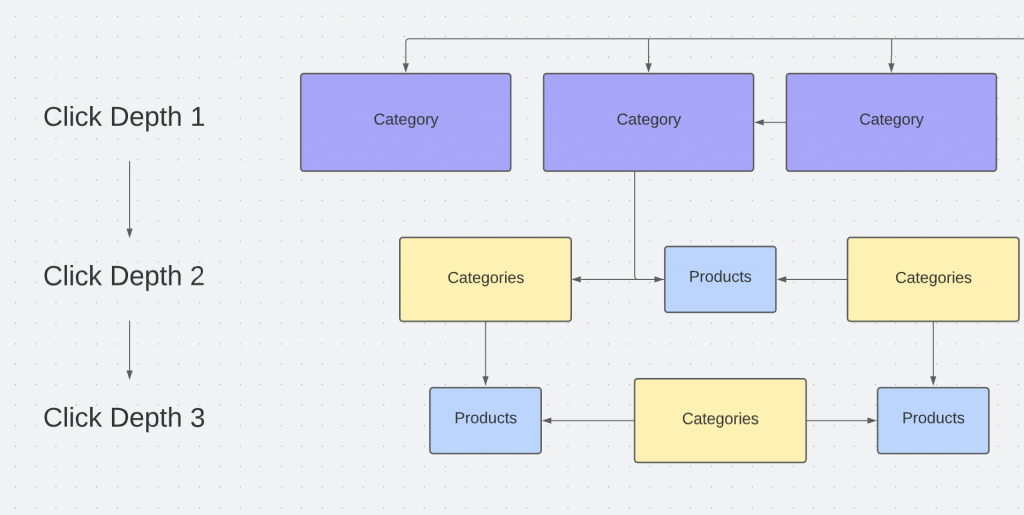
The effect is not just devolutionary – from the homepage on down – but also achieved through strategic cross-linking which continues to pass equity at the second and third click depths, leveraging what we might call “primary” categories (which are exposed in top navigation) as well as “secondary” categories which we find in a number of locations, including in internal product filter pages.
This flat information architecture is the basic strategy leveraged by ecommerce sites with large volumes of SKUs. Companies like Amazon, Etsy, or Saatchiart all reflect this basic structure in their information structure. Companies which are more intentional with their category types and category indexation strategy win the game by dominating space on the search results. Companies which crowd huge volumes of products exclusively under a few arbitrary categories make their products unfindable onpage without the aid of a free search function, and lose out on the torrent of qualified search traffic which a mindful architecture enables.