This post will cover a few mistakes to avoid in SEO localization. Aside from the first point on hreflang implementation, none of them map directly to what are generally regarded as international SEO best practices.
1. Don’t be underspecific in hreflang implementation.
Localization work is conducted according to “locales”. Locales are the combination of language + country, meaning that they account for country or region-specific linguistic usages.
Especially in cases where your choice of language and of locale are determined by the market you have targeted for expansion, it makes sense to target those regions specifically and with the full corresponding locale code for language + country, rather than leaving the country tag unfilled:
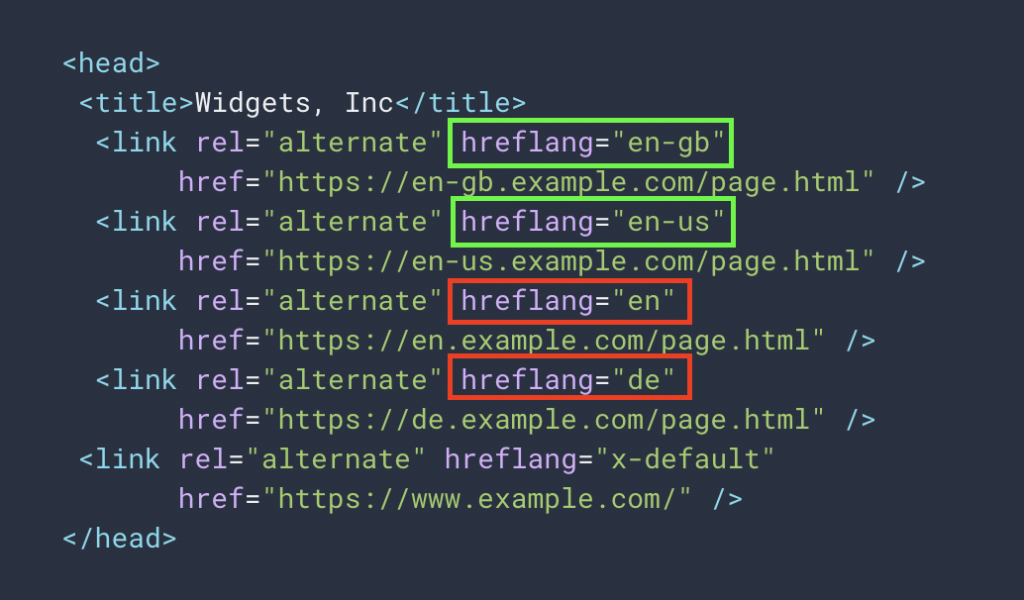
This is how locale-specific tagging looks, as an alternative to locale-agnostic tagging:
| Locale-specific Portuguese | Locale-agnostic Portuguese |
| hreflang=pt-AO (Angola) | hreflang=PT |
| hreflang=pt-PT (Portugal) | hreflang=PT |
| hreflang=pt-BR (Brazil) | hreflang=PT |
This is a soft choice, rather than a hard factor. But as with most SEO challenges, it is important to ask questions about value for the end-user. What is the value of inviting Google to send more traffic to this page from regions in which you are not active, and for which your content may not be suitably localized? Will this have a contrastive effect on your page’s competitiveness in the region you actually want to grow in?
Think instead in terms of the value of a strong specification: “This page has been produced specifically for this locale, contains content which is valuable to my users here, and is most optimal for serving their needs”.
Unless traffic chasing is actually your business model, it is better to be intentional with all SEO efforts.
2. Don’t create tons of properties you don’t need
Due to a desire to maximally reuse localized assets in every possible location (or just as likely, due to technical debt) some companies may produce a dozen or more properties per country as minimally helpful language variants.
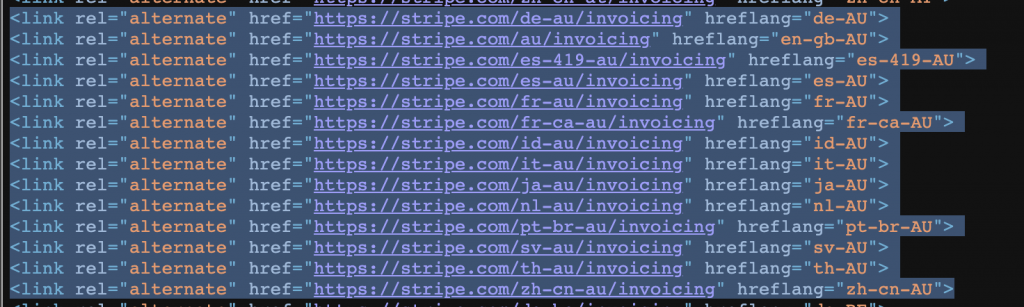
Consider the example of Stripe as in the case below. Do they need a French Canadian Australian (fr-ca-AU) variant of their website for Australian users? My guess is no.
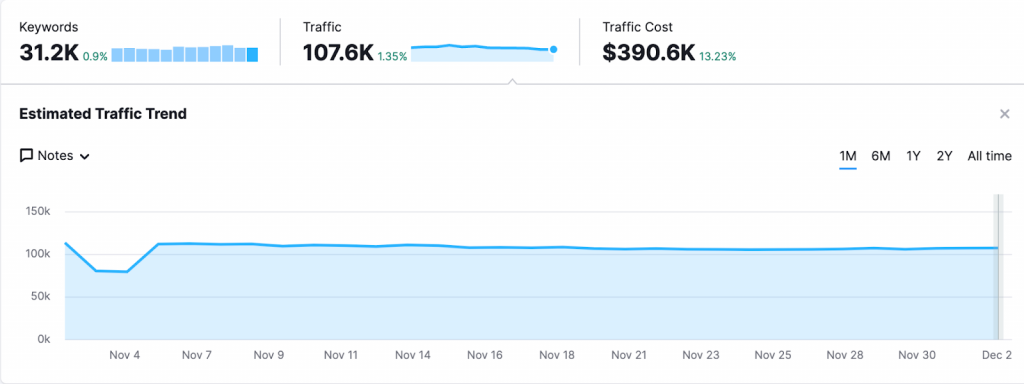
According to Semrush, Stripe in Australia pulls in just over 100,000 clicks a month from organic search:
But exporting this data, and looking at marketing properties (which are those affected by the large volumes of duplicated localized properties) according to their locale code, it appears that only English pages, and specifically their Australian-English specified properties, are driving major traffic:
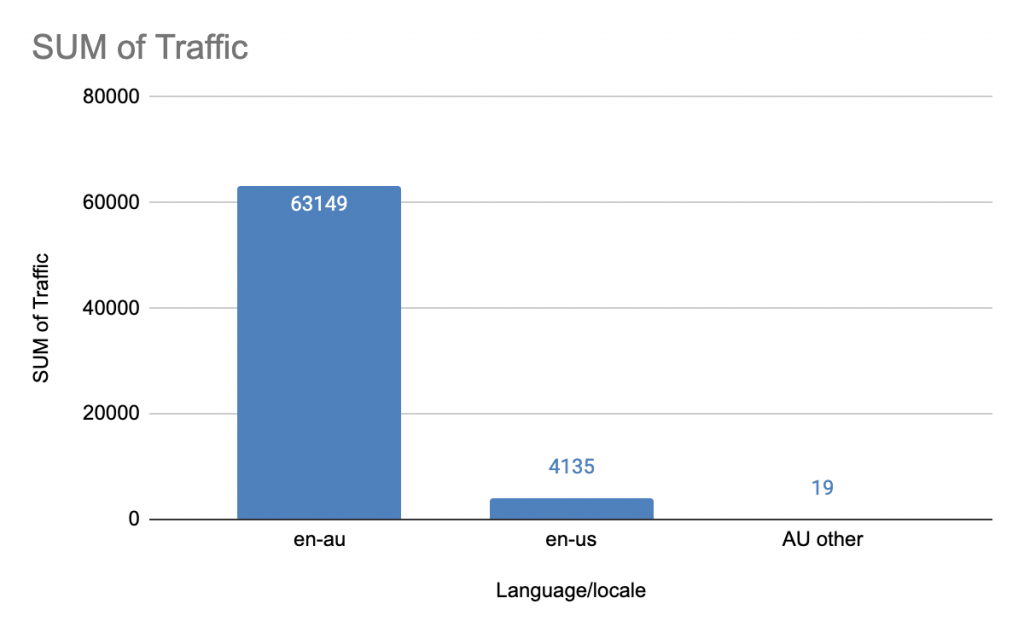
For all the language properties which Stripe created (including French Canadian Australia), they most likely pull in only a vanishing amount of traffic.
Clearly, this sort of strategy doesn’t have a lot of upside from an SEO perspective – but why do it? At the very least, it can have some of the following downsides:
- Makes tracking more complicated
- Introduces the possibility of duplicate content
- The wrong pages ranking in the wrong region (ex. en-us pages ranking in Australia)
If it is unduly difficult to optimize the setup to better align with best practices in this case, there are a few questions you can ask yourself:
- If this setup already exists, can you spot instances where duplicated sites are causing ranking issues?
- It is easy to make web changes (eg structured content)?
- It is easy to deploy updated strings simultaneously across all your ghost-localized properties?
The most important question to ask is always the following: Are you actually trying to target specific searchers in a given country who may be searching in a given language? French Canadian Australian would seem hard to justify as a target customer base. But there are lots of international users residing or traveling through Australia at a given time, and if there is a meaningful case for targeting them on search, it may be worthwhile maintaining some of these “ghost-localized” properties for those users specifically.
3. Localize Your Internal Linking
Internal linking is one of the most basic and important levers in SEO. You can support your pages on organic search through guaranteeing that your linking practices adhere to some of the following principles:
- Linking relationships are syntactically meaningful (anchor texts meaningfully describe the content located in the linked page.
- Linking relationships are semantically meaningful (links are established between pages which are related on a topical or conceptual level).
- Linking relationships are consistent or scaled in a way that is optimal for users and helps to more regularly expose your most important pages or page silos to crawlers.
On localized properties, teams sometimes neglect to ensure that all links on localized properties point users to localized contents. In other words, a page may be localized, but the links outbounding form that page may not be. This can be a simple (manual) oversight, for example in the following cases
- Your homepage icon or button links to your homepage in the source language.
- The links in your navigation haven’t been updated to reflect localized pages.
But on the level of individual pages, this is often due to the nature of string ingestion rules in translation management systems (TMSs). In order to avoid localizing an entire URL string (and thereby creating a translated version of an entire URL, which would then be useless), URLs are often excluded from string ingestion. For that reason, it is advisable to update your string ingestion rules in your TMS to ingest URLs but only ingest certain strings in the URL path, and allow your integration to populate localized URLs, if that is not otherwise taking place on the CMS-side. The ease of the fix depends on your localization setup, and will require SEOs, localization teams, and likely web or product teams working together to solve it.
To find instances where your internal linking is not localized, I use the following process, using Screaming Frog.
Non-localized linking in Navigation
- In order to reduce the noise in your data, begin by looking for non-localized patterns in navigation, ex. headers and footers. You can do this by starting from individual pages on localized properties, making sure to account for the fact that different site regions (ex. silos, subdomains, blogs vs main site vs careers site) may have different navigations. Crawl one representative page from each region in list mode to get a high level view of where link localization may be needed.
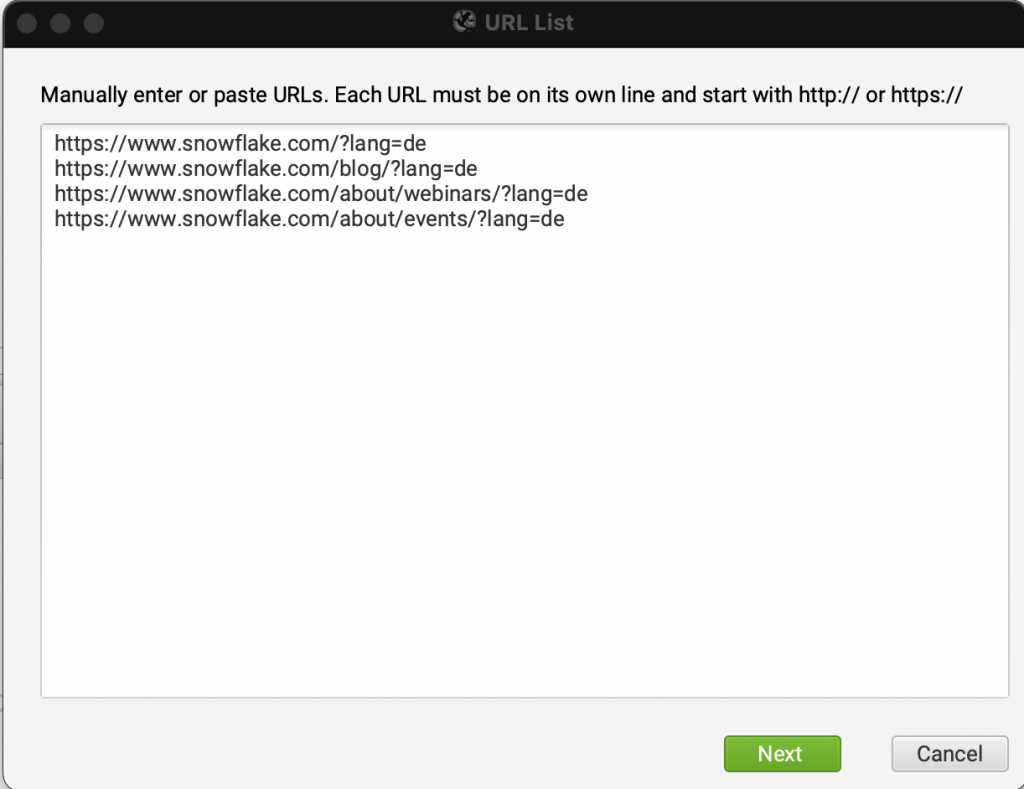
- After you have crawled these pages, highlight all pages under the “Internal” tab in the upper left corner, and toggle to the “Outlinks” tab in the bottom tray.
- Adjust the “Link Position” filter to include only Header and Navigation. This will allow you to spot any major issues that may scale across all pages in this site region.
- Export all links to a spreadsheet. Under the “To” column, you can see all the links to which a given page is pointing.
- Splitting on URL path, find all instances where your pages are linking
Non-localized linking in page content
- Crawl a list of URLs, either in spider mode or list mode. To save time, you may want to export a list of pages to crawl from the sitemap into list mode, using the importXML function or a query function, depending on whether the sitemap is formatted or unformatted.
For a formatted sitemap, a common solution is to use the following function:
=IMPORTXML("https://reductress.com/wp-sitemap-posts-post-1.xml","//*[local-name() = 'url']")For an unformatted sitemap, copy paste the entire sitemap to a sheet (“sitemap pasted”), then in a separate sheet call it with array formula which extracts the URLs.
=arrayformula(regexextract(query(sitemap pasted!A:A,"select * where A contains '<loc>'"),"^<loc>(.*?)</loc>$"))The first method pulls in a full list of URLs. In the second the query function selects all rows containing the <loc> tag, and then the regextract function extract all contents of that row between the open and closing <loc> tag.
- From here, the process is the same as above, but it may take some troubleshooting to find the most optimal Link Position. To reduce noise you can exclude Header, Navigation, and Footer, If “Content” doesn’t work as your filter for finding all links in <body> of your text, or there is no out of the box solution for aligning Link Position with the sidebar navigation in a blog post, for example, you may need to take a look at your data structure and find the HTML element which corresponds to a given area on a page. Screaming frog allows you to customize Link Position.
4. SEO does not mean automatic growth or revenue everywhere
Don’t expect organic search as a channel to provide the same value everywhere. Even with localized and optimized contents, there is no guarantee that you can expect the same ROI from search in all places.
This is particularly true as the purchasing path in many countries may weight against a linear model which places search at the top of the funnel, and assumes a predictable sequence of touchpoints.
The most important thing is always thinking about the mobile vs desktop (and app vs web) divide, and how a conventional purchase journeys for a customer in a target market may play out, contrasted to your assumptions based on your source market. In particular, social and app environments like Whatsapp, Wechat, or Pinterest may play specific and larger roles in many countries. Your channel segmentation for your source market may simply not map realistically to a proper channel segmentation for a target market.
5. Don’t expect outcomes in target markets that you can’t expect in source markets
This rule mainly relates to cases where SEO and localization functions are split or outsourced by different teams. In popular content on SEO localization, there is a lot of emphasis on differences across markets. In terms of resolution, this generally translates to “localize your keywords, don’t ‘translate’ them” or “check the SERPs”, which are best practices in any case.
But a more concrete difference can be elided as SEO tasks for international markets get charged to localization teams and outside agencies, especially at enterprise level, producing the following problem: teams identify that there is a specific problem or opportunity to do something in specific markets which doesn’t actually work in the source market.
The problem, then, is that SEO strategy as such isn’t really being pursuing in target markets, but certain expectations of organic search are being set which it can’t deliver on. In reality properly strategic SEO strategy is dependent in all cases on the search intent, Google’s ranking practices (e.g. “is this query satisfied by a video, by a product page, by a listings page, or by a blog post?”), and your business needs. When these factors converge, you should find that your strategic options are quite limited. This reflects the basic fact that SEO localization is basically anchored by the source text, source keywords, and source strategy.
Here are a few examples of possible misdirections that happen as SEO changes hands:
- Growing non-branded traffic through SEO in ways that don’t work in source, for example leveraging a 1P brand’s category pages to target non-branded keywords in foreign markets, where in fact such keywords are targeted precisely by resellers. The same conditions and outcomes will obtain in source and target markets.
- Growing branded traffic without first growing in-market presence in other ways. SEO can’t work wonders in terms of peoples’ interest in your brand in target markets. This is simply one of the hard stops of SEO.
- SEO localization for singular pages, without provisioning for stronger coverage across more pages or regions of localized sites. Throughput may very well make the difference here: expecting overnight success in organic search on the basis of fragmented localization choices ignores internal linking, demonstration of authority, and other signals that are critical to ranking in a target market.
- In addition to neglecting to localize for maximal coverage, neglecting to localize on a topical (i.e. semantic) basis means that individually localized contents are stranded from the content you have produced which ties them together, and demonstrates your brands and authors’ experience, expertise, authoritativeness, and trustworthiness (“EEAT”) in this space. Be mindful that brand authority is actually measured by search engines. This authority is largely a reflection of your pages, and is established in the connections among your pages.
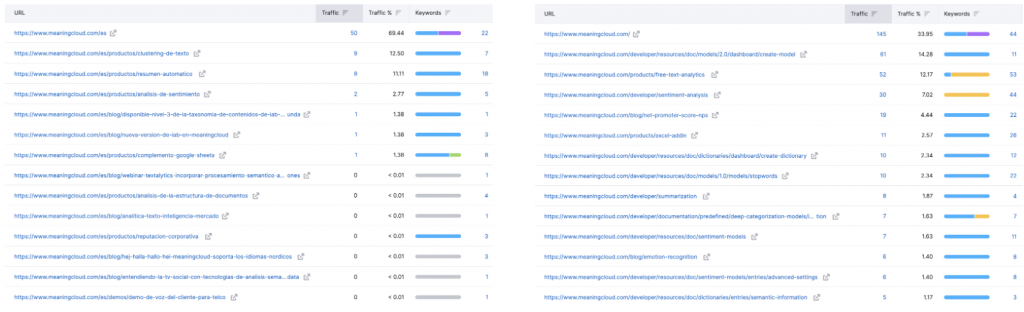
Whenever available, compare page (or competitor page) traffic and keywords in the target market to corresponding pages in the source market. In most cases, you can use the source as a guide for higher-level traffic objectives in the target market.
When it comes to SEO, localize as you would optimize for your target market
In general, the focus of SEO localization tends to be on proper adaptation of keywords from source to target markets. And indeed, there will be plenty of opportunities to accommodate for differences in local markets and to plan for edge cases. But provided you have actually proven out the case for localization in a given market (which should surface the needed accommodations), it’s best to not to reinvent the wheel: the same principles that lead to success in your source market should lead your SEO localization operations in a target market.
Be mindful, intentional, and use SEO strategy in your source market as a launching pad. Have an SEO localization strategy, reproduce your funnel to best serve customer intent, and optimize entities across languages.